Aligner Alchemy Academy
The community behind the movement, with 300+ dentists trained on the diploma. Strategy, clinical skill, marketing and litigation-safe growth in one membership. Cohorts, on-demand, and a live community.
Dr Bav (“Baverick”) Bhatt — founder of Digital First Dentistry and Aligner Alchemy Academy, former Clinical Growth Officer for a 10-practice group in London and the South East. DSOs and associates activated across UKI/EMEA.
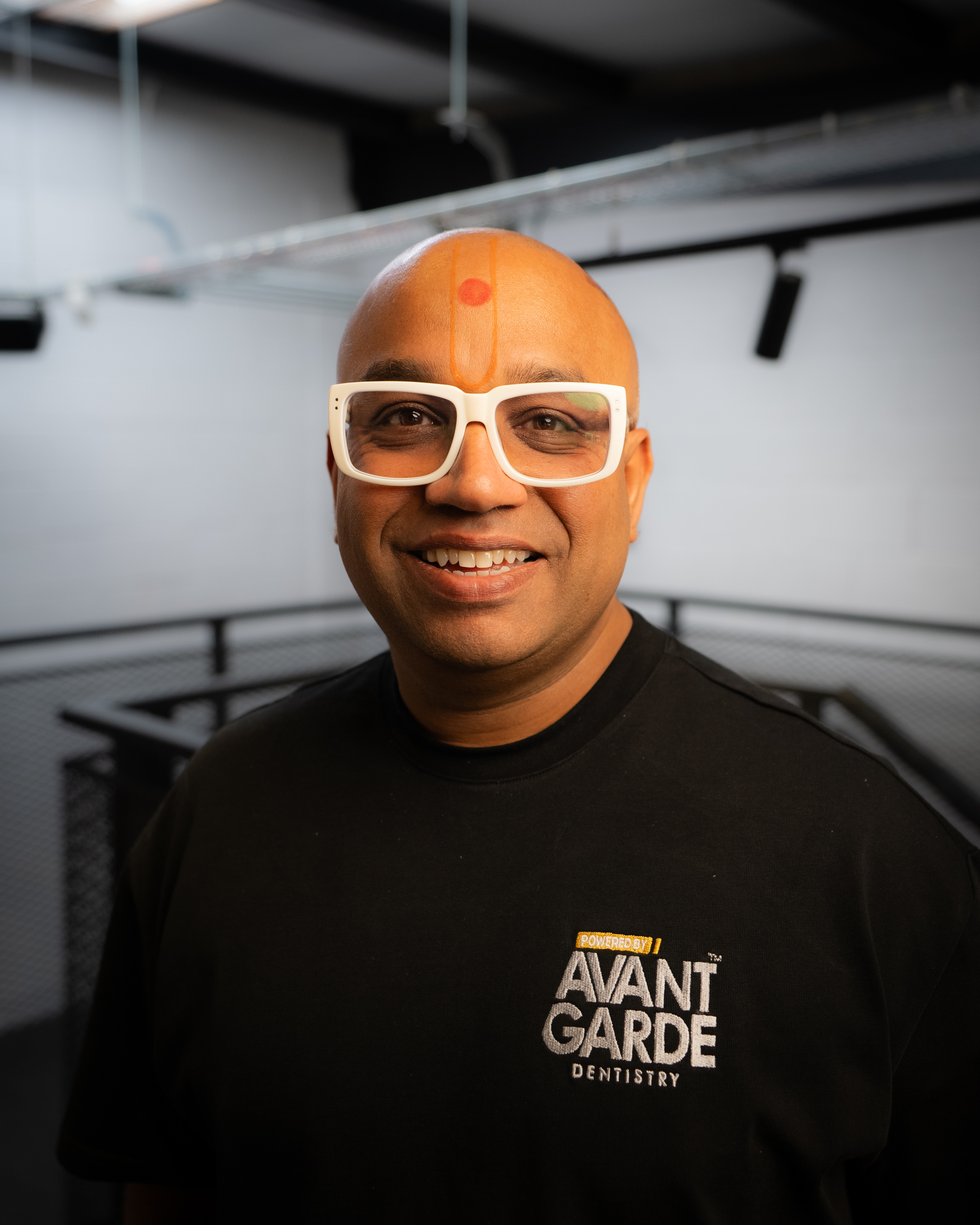
London-born. Royal London Hospital ’99. The same problem looked at from three different angles.
Phase 01 · The clinician
The first half of my career was the standard arc — associate, partner, three Essex practices. The pivot came when I started travelling to learn. NYU and Larry Rosenthal taught me cosmetics. The Kois Center in Seattle taught me occlusion — twice a year for ten years, until I founded the first UK Kois Study Group. Over twenty thousand cosmetic cases treated. Patients flying in from Kenya, Dubai, across the EU. By any honest measure I had become a world-class cosmetic clinician — and that’s when I noticed something quietly uncomfortable: the gap between what dentists could do with modern tools and what they actually did was enormous, and it wasn’t a clinical gap. It was a behavioural one.
Phase 02 · The educator
So I sold the practices. The first attempt at the bigger problem was Scan2Save & Scan2Sell — a 2018 venture that put a hundred iTero scanners into UK practices and taught me, painfully, that selling the technology was the easy half. Adoption was the real work. Aligner Alchemy Academy followed: a community of UK aligner dentists, with 300+ trained on the diploma, an EduQual-accredited Level 7 PG Diploma in Aligner Mastery, and the NGC App for daily-reps treatment-plan conversion. The voice changed from clinician to coach.
Phase 03 · The architect
The lesson from training more than 300 dentists was that individual coaching has a ceiling. The systems do not. Until September 2026 I was Clinical Growth Officer for a 10-practice group in London and the South East, and I now advise a multi-site group part-time, designing the operating models that turn aligner capability into case-volume predictability across multi-site DSOs and associate networks. The work has shifted from training individuals to engineering revenue architecture.
The thread through all three phases: change management for dentistry. Moving practices and teams from reactive single-tooth diagnosis to proactive, full-mouth, digitally-led care — and helping the industry that serves them learn how to teach the shift.
The other thread: my wife Meghana and our kids; the temple community in north London; and a Christmas habit of going back to rural India with the charity Wells on Wheels. The work that doesn’t bill is often the work that matters most.
I don’t think any single one of these makes me unusual. The combination might.
One of the foremost experts in cosmetic Invisalign treatments — an award-winning cosmetic dentist whose reputation is unmatched.
— Dentistry.co.uk
Recognised as the world’s foremost expert in iTero and Invisalign integration.
— Dentistry.co.uk
Few people sit at this intersection. Fewer still teach it.
Most DSO aligner programmes don’t fail because of product limitations. In multi-site environments the real growth constraint is rarely product access — it’s consultation structure, behavioural variance between providers, and the absence of a scalable operating model.
We redesigned the clinical workflow inside routine check-ups. No new technology, no new marketing spend, no discounting.
The commercial insight is simple: most DSOs are sitting on latent revenue inside their existing recall base. When consultation architecture is engineered correctly — case identification rises, conversion becomes predictable, digital tools become habitual, and revenue becomes structurally embedded.
The long-term impact isn’t just higher aligner numbers. It’s reduced dependency on external marketing, improved associate confidence and retention, stronger cross-sell across aligner, restorative and cosmetic lines, increased lifetime patient value, and sustainable same-store growth.
In DSOs, growth doesn’t come from new products. It comes from revenue architecture.
Most dentists own a scanner. Almost none operate one. The gap isn’t the technology — it’s the workflow no one taught them.
Aligner growth isn’t a marketing problem. It’s an operating-system problem. Fix the system and the cases follow.
Clinical excellence and commercial growth aren’t a trade-off. Done right, they’re the same conversation.
The next decade belongs to clinicians who learn to think like operators — and to organisations brave enough to teach them how.
Modern dentistry is a digital, business, and clinical problem all at once. I work across the four levers that move it.
General and restorative dentistry one day a week, digital-first, through Bhavin Associates.
Train the trainer for scanner, implant and aligner companies: their sales teams, clinical specialists and speaker faculty.
Aligner Alchemy Academy — 300+ dentists trained on the diploma — plus on-demand programs across the digital workflow.
Former Clinical Growth Officer for a 10-practice group in London and the South East; now a fractional adviser to a multi-site group. Industry advisory on scanner adoption.
I’m most useful to the people scaling this work past a single chair.
Multi-site groups trying to grow case-starts and conversion across a network without losing clinical quality or oversight. The framework is the same; the rollout is what changes.
Aligner and scanner brands building the training, content and adoption frameworks that turn shipped hardware into productive workflows. I’ve been on every side of this exchange.
Programs that need a clinician who can teach cosmetic depth, occlusion fundamentals and digital case planning — and who has already built an accredited PG-level curriculum.
Sales coaching, train the trainer and market insight for your teams. See the partner tiers.
Activated across UKI/EMEA. Free guides and tools for dentists at Digital First Dentistry.
Everything I do points at the same outcome: dentists who run the digital workflow with clinical confidence and commercial control. These are the three programs that get them there.
The community behind the movement, with 300+ dentists trained on the diploma. Strategy, clinical skill, marketing and litigation-safe growth in one membership. Cohorts, on-demand, and a live community.
Four partner tiers for scanner, implant, aligner and lab companies: sales coaching, train the trainer, market insight and customer education.
Next Generation Conversions — Duolingo-style daily training that lifts treatment-plan conversions across the whole practice team. Built for retention, not theatrics.
The operating system inside every coaching engagement.
90-day playbook for manufacturers, DSOs and faculty partners.
Workflow templates and SOPs for new aligner practices.
Aesthetic case planning for the digital age.
The yearly gathering for clinical operators.
The iTero workflow, upstream of the chair.
Available for keynotes, panels, faculty work and podcast guesting — clinical, commercial, or both at once.
My family supports Wells on Wheels — a charity bringing clean water to villages across rural India. My wife Meghana is a brand ambassador for the cause.
Read Meghana’s story →Christmas 2022 we took the kids to rural India to spend the holiday with girls supported by the charity. Some of the most important teaching I’ve done all year happens off-camera there.
Dentistry.co.uk →The reason I sold the practices and the reason I keep the calendar honest. Meghana, the kids, and the temple community in north London anchor everything else.
If you’re building something at the intersection of clinical excellence and the business of dentistry — an event, a curriculum, an adoption programme, a faculty seat, a multi-site rollout — I’d like to hear about it. London-based, increasingly transatlantic.